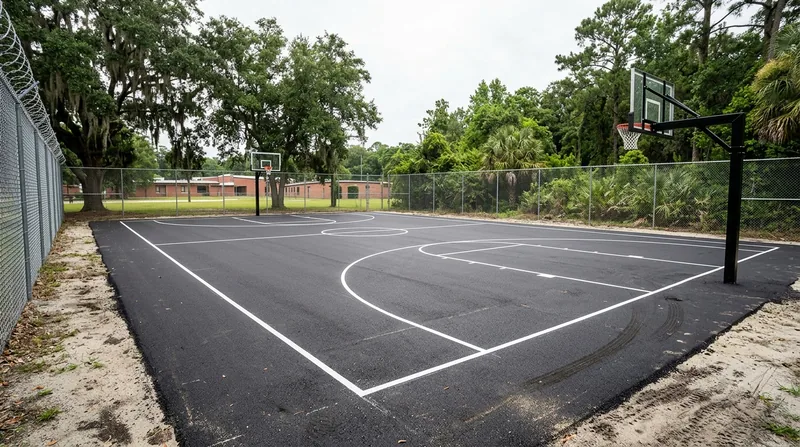




A sports court and path paving project in Savannah demands more than hot mix asphalt and a roller. Savannah's coastal plain sits on fine sand that drains fast at the surface but turns soft when the shallow water table rises under the near-daily afternoon thunderstorms of summer and hurricane season. A basketball court, tennis court, or recreational path that pools water becomes unsafe and fails fast. We build a compacted aggregate base, lay hot mix asphalt to proper thickness, and pitch the court to shed rain hard and clear. The result is a court that plays true and holds up through the humid months from June through November when most of the damage happens.
Why Sports Court and Path Paving Matters in Savannah's Climate
Savannah's weather is the enemy of flat surfaces. The city averages 50 inches of rain per year, with the heaviest concentrations in summer and early fall. A sports court built on poor drainage or a flat pitch becomes a liability. Standing water accelerates asphalt deterioration, creates safety hazards for players, and shortens the life of the surface by years. Unlike northern climates where frost heave and freeze-thaw cycles dominate, Savannah's failure mode is saturation. The ground beneath a court shifts when it holds water, and asphalt cracks follow. Proper grading and pitch are not cosmetic choices here, they are structural necessities.
- We establish a compacted base that sheds water away from the court surface and prevents pooling under heavy rain.
- We pitch the court to clear water fast during afternoon storms and hurricane season downpours.
- We size and compact the aggregate layer so the ground beneath does not shift when saturated.
- We lay asphalt to proper thickness for the intended use, whether recreational or competitive play.
A court built this way plays true and survives the Savannah summer intact.
Key info: The City of Savannah and surrounding municipalities in Chatham and Bryan counties require permits for any new impervious surface, including sports courts. Stormwater runoff rules apply, and some jurisdictions cap the percentage of a lot that can be paved. Always verify local requirements with your city before planning a court project. We help homeowners and HOAs navigate the permitting process.
How We Build a Sports Court or Path in Savannah
A sports court is not a driveway. It needs precise grading, correct drainage slope, and a stable base that will not shift under the weight of players or equipment. We start with a site visit to measure the area, check the existing grade, and plan the pitch. On Savannah's flat coastal terrain, we often need to cut and fill to establish the right slope. We then compact the aggregate base in lifts, proof roll it to confirm stability, and lay hot mix asphalt to the thickness required for the sport and use. The result is a court that drains, plays true, and lasts.
- We measure the site and evaluate existing grade and drainage.
- We plan the pitch and grading to shed water away from the court surface.
- We excavate and grade the base to the correct elevation and slope.
- We place and compact aggregate base material in layers, proof rolling to confirm density.
- We lay hot mix asphalt to the specified thickness for the intended use.
- We finish with a smooth, pitched surface ready for play.
The entire process takes care to get the invisible work right, because the surface is only as good as what lies beneath it.
Example: A residential basketball court in Richmond Hill required 2,400 square feet of paving on a lot that sloped toward the house. We cut the back corner 18 inches, graded the entire base to a 2 percent slope toward the street, compacted 6 inches of stone, and laid 3 inches of hot mix. The court now sheds rain in seconds and has played true for years. The same grading principles apply to tennis courts, pickle ball courts, and recreational paths throughout Savannah and Pooler.
Sports Court and Path Paving Methods
| Approach | Description | Best for |
|---|---|---|
| Full-Depth Build | Excavate to proper depth, install compacted aggregate base, lay hot mix asphalt to spec. | New courts on unpaved or poorly graded ground; sites where drainage is critical. |
| Grading and Overlay | Re-grade existing base to correct pitch, compact, lay new asphalt over sound subgrade. | Existing courts with poor drainage; sites where the base is stable but the pitch is wrong. |
| Recreational Path Paving | Build a narrow paved path with proper base and light pitch for pedestrian use. | Walking paths, garden paths, and connectors between courts or facilities. |
| Milling and Repave | Remove failed asphalt, re-grade and compact base, lay new hot mix to correct pitch. | Courts with alligator cracking or base failure; sites where drainage has never worked. |
Sports Court and Path Paving Cost in Savannah: What to Expect
A residential sports court in Savannah starts around $8,500 for a small basketball court or tennis court with proper grading and base prep. The cost depends on the size of the court, the condition and slope of the existing ground, how much excavation and grading is needed, and whether the base is sound or must be rebuilt. A court that sits on poorly draining ground or requires significant cut and fill costs more than one on stable, well-draining soil. Larger courts, competitive-grade surfaces, and sites with difficult access all move the price up. The best way to know what a project will cost is to have us visit the site, measure it, and give you a written estimate with tonnage and thickness specified. See our pricing page for typical ranges and factors that affect the total.
We recommend getting 2 or 3 estimates before you decide. A written estimate should include the square footage, the base thickness and type, the asphalt thickness, the pitch or drainage plan, and the total price. If an estimate does not include these details, ask for them. The cheapest price is not always the best deal, especially when drainage and longevity are at stake.
Sports Court and Path Paving Near Me: What to Look for When Hiring a Contractor in Savannah
Hiring a paving contractor for a sports court is different from hiring one for a driveway. A court must perform under use, which means the base, pitch, and asphalt thickness are not negotiable. When you are looking at contractors near Savannah, ask for references from other court projects they have completed. Ask to see the written estimate and make sure it specifies base depth, asphalt thickness, and the pitch or grading plan. Check that the contractor is fully insured. Ask whether they pull permits or help you navigate the local permitting process, because Savannah and surrounding cities require permits for new impervious surfaces and have stormwater rules. If your court is in an HOA, verify that the design and materials meet the HOA architectural standards before work begins.
- Confirm the contractor is fully insured and can provide a certificate of insurance.
- Ask for references from other sports courts they have built in the area.
- Get a written estimate with tonnage and thickness specified, not just a price.
- Verify that the contractor helps with local permitting and understands Savannah stormwater rules.
- Check HOA architectural guidelines before you commit, if your property is in a master-planned community.
- Ask how long the project will take and when the court will be ready for use.
A contractor who takes time to explain the grading, base prep, and pitch, and who puts it all in writing, is the one to hire. Call us at (912) 465-2393 or visit our contact page to schedule a free estimate. We have been in business since 2015 and we know Savannah's ground and weather inside out.
Sports Court & Path Paving in Savannah: Pricing Guide
| Service | Price | Details |
|---|---|---|
| Small residential court (basketball or tennis, 2,400 sq ft) | Starting at $8,500 | Includes compacted base, proper pitch, and 3-inch hot mix asphalt for recreational play. |
| Larger court or competitive grade (3,600+ sq ft) | Starting at $12,500 | Thicker asphalt, precise drainage grading, and materials suited for frequent or competitive use. |
| Recreational path paving (narrow, 100-500 linear feet) | Starting at $3,500 | Compacted base and light-duty asphalt for pedestrian pathways between courts or facilities. |
| Grading and re-pitch existing court | On estimate | Cost depends on excavation depth, soil conditions, and whether base must be rebuilt or re-compacted. |
| Free written estimate | Free | Response within 24 hours, includes site visit, measurement, and detailed scope with tonnage and thickness specified. |
Indicative pricing, the exact cost depends on square footage, finish, and site access. Free personalized estimate within 24h at (912) 465-2393.


