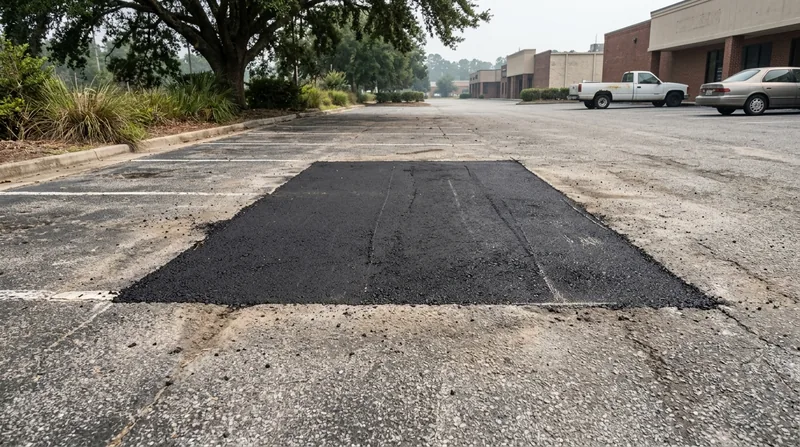




Parking Lot Repair & Resurfacing in Savannah starts with understanding why lots fail here. Savannah's coastal plain sits on fine sand that drains fast at the surface but softens the moment the water table rises under a summer storm, and near-daily afternoon thunderstorms from June through September do more damage to asphalt than any freeze ever could. A parking lot that cracks in patches usually points to sand shifting under a thin base, or to standing water working its way through and weakening the aggregate beneath. We cut out the failed section, rebuild the base, and patch it flush so the lot holds through the next tropical storm. If cracks cover thirty to forty percent of the surface or more, or if the damage runs deep, a full resurfacing makes more sense than patching. Call us at (912) 465-2393 for a free estimate, or read on to understand what we do and why it matters for your property.
Why Parking Lot Damage Accelerates in Savannah's Climate
Parking lots in Savannah face a unique set of stressors. The shallow water table means that heavy rain saturates the base quickly, and the long, humid summer keeps moisture trapped in the asphalt and substrate. Live oak roots can lift sections of older lots near the Historic District and in established neighborhoods, and the weight of parked vehicles over a soft or failing base creates alligator cracking that spreads fast. Unlike northern climates, where freeze-thaw cycles crack pavement in winter, Savannah's damage comes from water infiltration, thermal stress from rapid temperature swings, and the sheer volume of rain in a short season.
- Water seeps into small cracks and weakens the base layer, causing patches to sink and spread.
- Tree roots from nearby live oaks lift and fracture asphalt in older lots, especially in the squares and Ardsley Park.
- Alligator cracking signals that the base has failed and patching alone will not hold.
- Standing water after storms indicates poor grading or drainage, which must be addressed before resurfacing.
- UV exposure and the salt air near Tybee Island and Thunderbolt accelerate oxidation and brittleness.
Catching damage early and repairing it properly keeps a lot functional and safe for years. Ignoring small cracks turns them into expensive base failures.
Key info: A parking lot in Garden City or Port Wentworth that shows soft spots or puddles after rain likely has a base problem, not just a surface problem. Patching without fixing the base is money wasted. We inspect the failure and recommend repair or resurfacing accordingly.
How We Repair and Resurface Parking Lots in Savannah
Our process depends on the scope of damage. For isolated cracks and small failed sections, we cut out the damaged asphalt, clean the hole, inspect and compact the base, and patch it with fresh hot mix asphalt, feathering the edges so water sheds away and traffic flows smoothly. For lots with widespread cracking or a failing base, we mill off the top layer, rebuild the base where needed, and lay down a new wearing course. If the entire lot is beyond repair, we remove it, grade and compact the subgrade, rebuild the base, and pave a new lot from the ground up. Every job starts with a site inspection to measure the damage, understand the drainage, and check for tree roots or utilities.
- We cut out failed sections cleanly and inspect the base for soft spots or water damage.
- We compact and rebuild the aggregate base where it has failed or settled.
- We patch with hot mix asphalt matched to the existing lot, feathered and compacted flush.
- We grade the lot to shed water away from low spots and toward storm drains.
- For widespread damage, we mill the old surface and lay a new overlay or full replacement.
- We call Georgia 811 before any excavation to locate utilities and prevent damage.
Every repair is built to last through Savannah's summer storms and the heavy traffic of a busy lot.
Example: A small shopping center lot in Savannah showed alligator cracking in the northeast corner and a soft spot near the storm drain. We cut out the failed section, dug down to find sand and silt that had washed into the base, removed and compacted the subgrade, rebuilt the base with proper stone, and patched it with hot mix. The lot has held through two hurricane seasons since.
Parking Lot Repair Methods and When to Use Each
| Approach | Description | Best for |
|---|---|---|
| Pothole and Crack Patching | Cut out the failed section, clean, compact the base, and fill with hot mix asphalt. | Isolated failures, soft spots, and small potholes in otherwise sound lots. |
| Asphalt Overlay | Mill off the top layer and lay down a new wearing course over the existing base. | Lots with surface cracking but a sound base, or to add thickness before failure spreads. |
| Milling and Removal | Remove the entire asphalt surface and haul away the millings or recycle them. | Preparing for a full replacement or when the base needs complete rebuilding. |
| Full-Depth Replacement | Remove all asphalt, rebuild the base, and pave a new lot from the subgrade up. | Lots with failed bases, extensive alligator cracking, or poor drainage that cannot be fixed by overlay. |
| Grading and Drainage Repair | Regrade the lot to shed water, repair or install storm drains, and compact the subgrade. | Lots with standing water, soft spots, or poor drainage that accelerate damage. |
The right method depends on how much of the lot has failed and whether the base is still sound. We inspect the lot and recommend the most cost-effective repair that will actually hold.
Parking Lot Repair & Resurfacing Cost in Savannah: What to Expect
Parking lot repair and resurfacing pricing in Savannah depends on the size of the lot, the extent of the damage, and the method you choose. A small pothole repair or isolated crack patch starts at around $650 and covers the labor and materials to cut out the failed section, prepare the base, and patch it flush. A full-lot resurfacing or overlay, which covers a typical small commercial lot, runs higher and is quoted on site once we measure the square footage and assess the base. Full-depth replacement, which involves removing the entire lot and rebuilding it, is the most expensive option but is necessary when the base has failed or when extensive alligator cracking means an overlay will not hold.
Factors that affect the cost include the total square footage of the lot, the depth of damage and whether the base needs rebuilding, the ease of access for equipment, whether we need to remove and haul away old asphalt, the complexity of drainage work, and whether tree roots or utilities complicate the job. A lot in Pooler or Richmond Hill with good access and a sound base costs less per square foot than a tight downtown lot in the Historic District where equipment access is difficult and we must work around nearby structures or live oak roots.
The best way to know what a repair will cost is to get a free estimate. We measure the lot, inspect the damage, and provide a written quote with tonnage and thickness specs so you know exactly what you are getting. Visit our pricing overview for more detail on how we structure estimates, or call (912) 465-2393 to schedule a free site visit.
Parking Lot Repair & Resurfacing Near Me: What Savannah Property Owners Should Know When Hiring
When you are looking for a contractor to repair or resurface your parking lot, start by verifying their insurance and asking to see a certificate of coverage. In Georgia, a contractor holding a state residential or general contractor license is required only for jobs exceeding $2,500 in combined labor and materials. That threshold is a low bar, and an ordinary parking lot repair or resurfacing is normally above it. Ask any contractor whether they hold the required license and verify it with the Georgia Secretary of State if the job is large. Request a written estimate with specific measurements, tonnage, and thickness specs, not a vague per-square-foot range. Get at least two or three estimates so you can compare scope and price.
Check references from recent lot repairs or resurfacing jobs in Savannah, Pooler, or nearby areas. A contractor who has done work in your neighborhood understands the local soil, water table, and storm patterns. Ask whether they handle permitting and drainage work, because many municipalities in the Savannah area require permits for parking lot work or changes to stormwater runoff, and some HOAs or commercial properties have architectural standards that must be met. Avoid any contractor who shows up unsolicited, offers a price that is too good to believe, asks for a large cash deposit upfront, or carries out-of-state plates and no written contract. These are the hallmarks of transient crews that disappear after taking your money.
Savannah Asphalt Paving has been serving the area since 2015, and we are fully insured. We provide free estimates within 24 hours, written quotes with tonnage and thickness, and we handle all the details of drainage and base preparation so your lot is built to last. Contact us to schedule your free inspection.
Parking Lot Repair & Resurfacing in Savannah: Pricing Guide
| Service | Price | Details |
|---|---|---|
| Pothole or crack patch | Starting at $650 | Cut out failed section, prepare base, patch with hot mix asphalt, feather edges for water shedding |
| Asphalt overlay or resurfacing | From $1.25 per sq ft | Mill existing surface, rebuild base where needed, lay new wearing course, includes drainage assessment |
| Full-depth replacement | On estimate | Remove all asphalt, rebuild base and subgrade, pave new lot; requires site inspection for accurate pricing |
| Grading and drainage repair | On estimate | Regrade lot to shed water, repair or install storm drains, compact subgrade; priced based on extent of work |
| Estimate and site visit | Free | Includes measurement, damage assessment, written quote with tonnage and thickness specs, no obligation |
Indicative pricing, the exact cost depends on square footage, finish, and site access. Free personalized estimate within 24h at (912) 465-2393.


