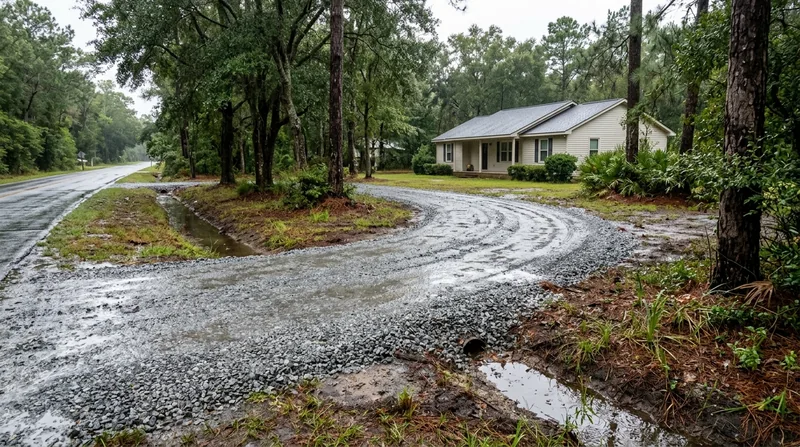




Savannah's coastal plain sits on fine sand that drains fast at the surface but turns soft the moment the shallow water table rises under a summer storm. A gravel driveway without real grading becomes a muddy rut after the near-daily afternoon thunderstorms that define the humid season here, and standing water collects in every low spot. Gravel driveway installation and grading in Savannah means shaping the base with a proper crown, compacting the stone so it holds through the wet season, and pitching the surface to shed water fast. We shape the base, set drainage, and compact the gravel so it stays solid and doesn't wash or settle into the soft ground beneath. A well-graded gravel drive can serve a rural property or a long approach for years, but only if the water runs off instead of pooling.
Why Proper Grading Matters on Savannah's Flat Ground
Savannah's terrain is relentlessly flat, and that flatness is the enemy of a gravel driveway. Without grading, water has nowhere to go. The shallow water table rises in summer, and the fine sand and marsh mud underneath cannot hold weight once they are saturated. A gravel surface that sits level or dips in the middle will collect standing water after every storm, and that water softens the base until the gravel sinks, ruts form, and the drive becomes impassable. Proper grading creates a crown, a slight peak down the center or along the length of the drive, so water runs off to the sides and into drainage swales or into the surrounding ground where it can disperse.
- A crowned gravel surface sheds water immediately after rain instead of letting it pool.
- Compacted base material stays firm under weight and does not settle into soft ground.
- Proper pitch prevents rutting and washboard texture that forms when water erodes loose stone.
- Drainage swales or side berms direct water away from the drive and protect the subgrade.
- Regular raking and light compaction after heavy rain keeps the surface stable through the wet season.
Without grading, a gravel driveway in Savannah becomes a liability within a single wet season.
Key info: Savannah's summer thunderstorms deliver inches of rain in minutes. A flat or poorly pitched gravel drive will pond water that softens the fine sand base, causing ruts and settling within weeks. Proper crown and compaction are not optional.
For more detail on how we handle base preparation for asphalt and other paved surfaces, see our asphalt driveway paving page, which covers the same grading principles applied to a permanent surface.
How We Grade and Install a Gravel Driveway in Savannah
Gravel driveway installation starts with site assessment and grading. We measure the existing grade, identify high and low spots, and plan the crown and drainage. We then excavate and compact the subgrade, lay down a base course of larger crushed stone, and top it with a smaller gravel or crushed-stone finish layer. The key is compaction at every stage and a slope that moves water off the surface fast.
- We assess the site and plan the crown and drainage layout before any equipment arrives.
- We excavate soft or unsuitable material and compact the subgrade with a vibratory compactor.
- We lay a base course of larger crushed stone, typically 4 to 6 inches, and compact it thoroughly.
- We top the base with a finish layer of smaller gravel or crushed stone, 2 to 3 inches, and proof-roll the entire surface.
- We shape the crown and side berms so water runs off immediately and does not collect.
The finished drive is ready to use right away and will hold firm if water is managed correctly.
Local example: A rural property in Richmond Hill with a 150-foot approach through soft ground needed a gravel drive that would not wash out in summer. We excavated 18 inches, laid 6 inches of compacted base stone, topped it with 2.5 inches of finish gravel, and pitched the crown at 4 percent. The drive has held for three years with seasonal raking and no rutting.
If your property is suited for asphalt instead of gravel, we also offer driveway replacement and full-depth paving for a more permanent solution.
Gravel Driveway Methods and Materials
| Approach | Description | Best for |
|---|---|---|
| Crushed Stone Base with Gravel Finish | 6 inches of compacted 3/4-inch crushed stone topped with 2 to 3 inches of smaller gravel or crusher run. | Rural properties, long approaches, and sites where a stable, long-lasting gravel surface is the goal. |
| Recycled Asphalt Millings | Compacted RAP (recycled asphalt pavement) 4 to 6 inches thick, which binds as it settles and hardens over time. | Budget-conscious owners, shorter driveways, and sites where a semi-permanent surface is acceptable. |
| Crusher Run (Dense Grade Aggregate) | Angular crushed stone that compacts densely and resists washboard; used as both base and finish layer. | High-traffic driveways, areas with steep pitch, and properties where gravel migration is a concern. |
| Grading and Compaction Only | Excavation, subgrade compaction, and crown shaping without new stone; existing gravel is raked and re-compacted. | Maintenance of existing gravel drives and sites where the base is sound but the crown has settled. |
Gravel Driveway Installation and Grading Cost in Savannah: What to Expect
Gravel driveway installation and grading in Savannah typically starts at around $950 for a short rural approach on stable ground with minimal excavation. The final cost depends on the length and width of the drive, the depth of excavation required, the soil conditions (fine sand drains fast, but marsh mud and soft spots require deeper prep), the type and quality of stone chosen, and the equipment needed to access the site. A longer driveway in a newer subdivision south or west of the city, where the water table is higher and the ground softer, will cost more than a short approach on firmer ground. We provide a written estimate with tonnage and material specifications, so you know exactly what you are paying for.
The factors that move cost up are straightforward: a longer drive, deeper excavation to reach stable ground, softer subgrade that requires more compaction, and premium stone materials. A 100-foot drive on flat ground with shallow excavation and standard crushed stone is less expensive than a 250-foot drive through wet, soft ground that needs 18 inches of prep and imported base material. We recommend getting 2 to 3 estimates so you can compare not just price but the scope of work, the materials specified, and the depth of compaction proposed. A cheap estimate that skips compaction or uses too little base stone will fail in the first wet season.
For a detailed pricing overview of all our services, including gravel and other driveway types, visit our pricing page.
Gravel Driveway Installation and Grading Near Me: What Savannah Homeowners Should Know When Hiring
When you hire a contractor for gravel driveway installation and grading near Savannah, verify that they are fully insured and ask for a certificate of insurance. Request a written estimate that includes the length and width of the drive, the depth of excavation, the base material and finish material with tonnage, the compaction method, and the crown pitch. Ask for references from recent projects in Savannah, Pooler, Richmond Hill, or Garden City so you can see how their work has held up through a wet season. If your property is in an HOA or a master-planned community, check the architectural guidelines before you start, because some HOAs restrict gravel drives or require approval before work begins. Confirm with the Savannah building department or your local city whether a permit is required, because grading and fill material can trigger stormwater or impervious-surface rules in some jurisdictions.
- Ask the contractor for proof of insurance and check that coverage is current and adequate.
- Request a written estimate with material types, tonnage, compaction specs, and a site plan showing crown and drainage.
- Call the local building department to confirm whether a permit is required for grading or fill material on your property.
- Review your HOA covenants or architectural guidelines to ensure a gravel drive is permitted and approved.
- Ask for references from completed projects in the Savannah area and follow up by phone or email.
- Verify that Georgia 811 utility locates are called before any excavation begins, as required by law.
A contractor who provides a clear, detailed estimate and references you can verify is the one to trust.
If you are ready to move forward, contact us for a free estimate. We will assess your site, answer your questions about grading and drainage, and provide a written scope and price with no obligation to book.
Gravel Driveway Installation & Grading in Savannah: Pricing Guide
| Service | Price | Details |
|---|---|---|
| Short Gravel Driveway (up to 75 feet) | Starting at $950 | Includes site grading, 4-inch base course, 2-inch finish layer, and compaction on stable ground |
| Standard Rural Approach (75 to 200 feet) | Starting at $1,800 | Includes excavation, 6-inch base course, 2.5-inch finish, crown shaping, and drainage swales on softer soil |
| Long Driveway or Soft Ground (200+ feet or marsh/mud) | Starting at $3,200 | Includes deeper excavation, imported base material, enhanced compaction, and site-specific drainage design |
| Recycled Asphalt Millings Option | Starting at $1,200 | 4 to 6 inches of compacted RAP for a semi-permanent surface that binds and hardens over time |
| Free Estimate | No charge | Site visit, material recommendations, written scope, and price within 24 hours at (912) 465-2393 |
Indicative pricing, the exact cost depends on square footage, finish, and site access. Free personalized estimate within 24h at (912) 465-2393.


