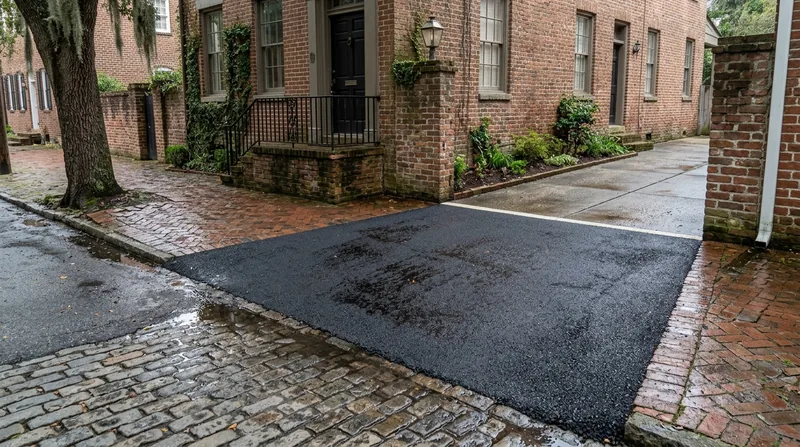




Driveway Extensions, Widening & Aprons in Savannah solve a persistent problem in our city's residential landscape. Whether you own a Victorian in Ardsley Park with a narrow single-width drive, a townhome near the Historic District squares with a tight shared apron, or a mid-century ranch on the Southside where an extra bay or turnaround would ease parking, extending or widening your driveway requires local expertise. Savannah's sandy, fast-draining base sits above a shallow water table that rises under summer thunderstorms, and our near-daily afternoon deluges demand that new asphalt tie seamlessly into existing surfaces, pitched correctly to shed water fast. We extend driveways by matching grade, compacting aggregate base properly, and laying new asphalt flush with butt joints so runoff clears your lot during the storms that dominate our long, humid season. A driveway extension or widening is often the highest-value improvement we perform on a repair visit, and it pays for itself in convenience and resale appeal.
Why Driveway Extensions and Widening Matter in Savannah's Tight Urban Lots
Savannah's housing stock was built on narrow lots and tight setbacks. The brick townhomes around Forsyth Park and the Historic District squares share driveways and aprons with neighbors, and a single-car-width drive was standard for the Victorian and early 20th-century homes that define South Savannah. Today, most households run two or more vehicles, and a narrow apron that barely fits one car becomes a daily frustration. A second vehicle parks on the street, or a delivery truck blocks the sidewalk. A driveway extension or widening not only solves that problem, it increases your property value and improves sight lines for safety. Extending a drive into unused side or back yard space is often cheaper than you think, and the work ties directly into asphalt driveway paving and installation on the same visit.
- Extend a narrow single-width drive by one car width to fit two vehicles side by side.
- Widen an existing apron to improve vehicle access and sight lines at the street.
- Add a turnaround or parking bay in a side or back yard to eliminate street parking.
- Tie new asphalt to existing pavement with proper grading and base compaction so water runs off and joints do not fail.
- Verify local setback, impervious-surface, and curb-cut rules with your city before design, because Savannah, Pooler, Richmond Hill, and Garden City each have different standards.
Extensions and widenings are common work in Savannah's established neighborhoods, and the difference between a good job and a failed one is base preparation and pitch.
Key info: Savannah's Chatham County stormwater rules limit impervious surface on residential lots and require permits for most driveway extensions. Always check with the Savannah Planning and Zoning Department or your local city building office before we start work, because the rules vary between the city proper, Pooler, Richmond Hill, Garden City, and unincorporated areas. HOAs in master-planned communities like those on the west side of Savannah frequently require approval for any driveway change, and aesthetic standards often apply.
How We Extend and Widen Driveways in Savannah: Process and Local Approach
A driveway extension or widening in Savannah starts with a site visit to measure the existing drive, check the slope and drainage, identify underground utilities, and understand the soil and water table depth. Savannah's fine sand drains fast at the surface but turns soft when the water table rises, so we always compact the base properly and pitch the new section to shed water toward the street or a drainage swale. We call for a Georgia 811 utility locate before any excavation, tie the new asphalt to the existing drive with a butt joint, and ensure the transition is smooth and flush so water does not pool at the seam.
- Visit your site to measure, photograph, and assess existing grade, drainage, and soil conditions.
- Request a Georgia 811 utility locate at least 48 hours before excavation to identify buried electric, gas, water, and sewer lines.
- Excavate and grade the extension area, removing topsoil and compacting the base to proper density.
- Lay a compacted aggregate base layer to support the asphalt and allow water to drain without pooling.
- Pave the new asphalt section and tie it flush to the existing drive with a butt joint, pitched so water runs off toward the street.
- Confirm that the finished surface matches the grade of the existing drive and that runoff clears your lot during heavy rain.
The entire process usually takes one to two days, depending on the size of the extension and whether the base needs rework due to soft spots or poor drainage.
Local example: A Victorian home in Ardsley Park with a single-width drive needed to fit two cars. We extended the drive 8 feet into the side yard, compacted the base over fine sand, and pitched the new section to shed water toward the street. The job took one day and cost less than a second vehicle would pay in parking tickets over a year. The same approach works for ranch homes on the Southside and townhomes near the squares, where space is tight but demand for parking is high.
For more detail on how asphalt is properly installed and compacted, see our page on asphalt resurfacing and overlay, which covers base preparation and paving technique.
Methods and Materials for Driveway Extensions and Widening
| Approach | Description | Best for |
|---|---|---|
| Full-depth asphalt extension | Excavate, compact aggregate base, lay 2 to 3 inches of hot mix asphalt, tie flush to existing drive with butt joint. | Standard residential extensions and widenings in Savannah, Pooler, Richmond Hill, and surrounding areas. |
| Recycled asphalt millings extension | Grade and compact recycled asphalt millings (crushed reclaimed asphalt) as base and wearing surface, lower cost and environmentally efficient alternative. | Budget-conscious homeowners, rural properties, and situations where new hot mix is not required by local code or HOA. |
| Gravel or shell extension with grading | Grade the extension area, compact shell or gravel base, and pitch for drainage, no asphalt applied. | Rural or cottage properties, temporary parking areas, and situations where impervious-surface rules limit asphalt. |
| Tar and chip extension | Grade and compact base, apply liquid asphalt binder, and top with stone chips, lower cost than hot mix with a rustic appearance. | Historic properties, HOAs with specific aesthetic rules, and homeowners seeking a softer look than black asphalt. |
The choice of material depends on your budget, local code requirements, HOA rules, and whether the extension is permanent or temporary. We recommend hot mix asphalt for most residential extensions in Savannah because it bonds reliably to existing pavement, sheds water in our intense summer storms, and holds up under repeated freeze-thaw cycles in the rare event of winter cold. Recycled millings work well for rural driveways and budget extensions, and gravel is appropriate where impervious-surface limits apply. Always verify local requirements with the Savannah Planning and Zoning Department or your HOA before we start.
Driveway Extensions, Widening & Aprons Cost in Savannah: What to Expect
A typical driveway extension in Savannah starts at around $1,800 for a modest 8-by-10-foot addition with standard base preparation and new asphalt. The final cost depends on several factors: the size of the extension (square footage), the condition and compaction of the existing base, whether utilities need to be located and protected, local permit fees, and whether you choose hot mix asphalt, recycled millings, or another material. A widening that adds 4 to 6 feet of asphalt to an existing 10-foot drive costs less than a full extension, while a large turnaround or multi-space parking bay in a back yard can run higher. Getting two or three written estimates from local contractors is always smart, because site conditions vary and some drives need more base work than others.
See our full pricing overview for detailed cost guidance by project type and size. We provide written estimates with tonnage and thickness specifications, so you know exactly what you are paying for before we begin work.
Driveway Extensions, Widening & Aprons Near Me: What Savannah Homeowners Should Know Before Hiring
Hiring the right contractor for a driveway extension or widening means checking credentials, understanding permits, and getting clarity on what the job includes. Start by confirming that any contractor you consider is fully insured and carries liability coverage for the work. Ask for written estimates that include material specifications, thickness, and tonnage, not just a per-square-foot price. Verify that your local city or county requires a permit for the extension, because Savannah, Pooler, Richmond Hill, and Garden City each have different rules about setbacks, impervious surface, and curb cuts. If your property is in an HOA or historic district, confirm that the extension meets architectural standards and any size or material restrictions before you commit to a contractor. Check references from recent work in your neighborhood, because a contractor who understands Savannah's sandy base and water table will deliver a drive that lasts.
- Verify that the contractor is fully insured and ask to see a current certificate of liability coverage.
- Request a written estimate that specifies asphalt thickness, aggregate base depth, and material tonnage, not a price per square foot.
- Confirm with the Savannah Planning and Zoning Department or your local city building office whether a permit is required before work begins.
- Check with your HOA or historic district commission if your property is subject to architectural review, because approval may be required.
- Ask for references from at least two recent driveway extensions or widenings in Savannah or nearby areas.
- Ensure the contractor will request a Georgia 811 utility locate at least 48 hours before any excavation.
A reputable local contractor will answer these questions directly and without hesitation. Contact us at savannah-asphalt.com/contact for a free, no-obligation estimate, and we will walk you through the process and answer any questions about permits, materials, and cost.
Driveway Extensions, Widening & Aprons in Savannah: Pricing Guide
| Service | Price | Details |
|---|---|---|
| Small extension (8x10 to 10x12 feet) | Starting at $1,800 | Includes base preparation, compaction, and full-depth asphalt, tied flush to existing drive with proper pitch for drainage. |
| Widening (adding 4 to 6 feet to existing drive) | Starting at $2,200 | Extends existing drive width, includes new aggregate base, compaction, and hot mix asphalt bonded to current surface. |
| Large extension or turnaround (12x16 feet or larger) | Starting at $3,500 | Multi-space parking area, back-yard turnaround, or complex grading, cost varies with site conditions and soil prep needed. |
| Recycled asphalt millings or gravel extension | Starting at $1,200 | Budget alternative to hot mix, includes grading and compaction, suitable for rural properties or where code permits. |
| Estimate and site visit | Free | We measure, assess drainage and base conditions, and provide a written estimate within 24 hours at (912) 465-2393. |
Indicative pricing, the exact cost depends on square footage, finish, and site access. Free personalized estimate within 24h at (912) 465-2393.


